
April 2026 Oracle EPM updates are finally here! To say this is a long time coming is a big understatement. We have not had an EPM update since November 2025, and that one only went to test environments. This one has a bit of everything: infrastructure, REST APIs, Groovy, IPM. Oh, and Fusion AI Agents! Updates will go to test environments April 3rd and prod environments April 17th. Let’s get into it.
Oracle-Managed Migration of an Environment to a New Environment with a Different SKU or in a Different Region, Cloud Account or IAM Domain
This is an improvement to the process of migrating to a new environment under a different SKU, region, or domain, and keeping the URL of the existing environment. Previously, we would have to clone the existing environment and not be able to continue using the existing URL. This change will help with upgrading to Enterprise SKU.
Gen AI Now Available in All Regions in the OC1 Realm
All regions in the OC 1 realm now have Gen AI available. If you haven’t been paying attention, AI is a priority for Oracle and this is yet another step in that journey.
EPM Automate Windows Installation Changes
The default installation folder for EPM Automate is now in the Program Files directory on Windows computers (Program Files\Oracle\EPM Automate). Additionally, by default, log files, password files, downloaded files, user preferences, and other runtime data will also be saved within this folder. This could impact EPM Automate scripts. Per Oracle:
- Any files referenced by scripts from the default location (for example, source files used with the uploadFile command) are expected to reside in the ProgramData\Oracle\EPM Automate folder.
- The password encryption file referenced without an absolute path in the script must be present in the ProgramData\Oracle\EPM Automate folder
New REST APIs to Support Agentic AI Interaction
Three new REST APIs are available for Agentic AI interactions with EPM Cloud. Get Application Summary returns an AI focused summary of the specified EPM application. Export Data returns a JSON data grid containing the query results for programmatic export of large datasets. Export Form Data returns a JSON grid with data for a slice defined by the specified form.
IDCS Group Audit Information Included in the Group Assignment Audit Report
The EPM Automate command groupAssignmentAuditReport has been enhanced to show audit information for the specified data range. This information was not retrieved before. The associated REST API has also been updated.
Essbase Block AnalysisReport to Show Percentage of Essbase Blocks with Near-Zero Values
The EPM Automate command (and associated REST API) essbaseBlockAnalysisReport has been updated to include the percentage of data cells with values close to zero within Essbase blocks. A high percentage of near zero values can have adverse effects and cause performance problems in applications. Being able to identify the percentage of affected blocks is helpful.
Mandatory Groovy Update Coming in May 2026 (26.05 Update)
While originally planned for November, and then rescheduled for December, and then January, this update is now happening in May 2026. The Groovy engine is being updated with stricter validation rules. Check your scripts ASAP and make necessary corrections now to avoid problems later.
Groovy Rules to Support the Copying of Relational Data, Comments, Attachments, and Supporting Details
Groovy rules can now be used to copy relational and Essbase data, comments, attachments, and supporting details. This helps with automating the copying of this information.
Updated EPM Books Extension for Smart View
There is an updated EPM Books extension for Smart View. As always, I recommend updating Smart View extensions when they are available.
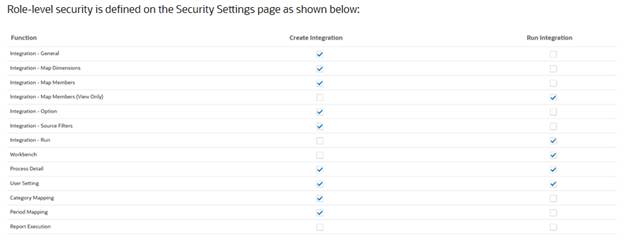
Customization of Data Integration Roles
The two rules in Data Integration “Integration – Create” and “Integration – Run” can now be customized by Service Administrators. I like this flexibility. Someone with the Run role can be given the ability to edit mapping. Or something can be removed from a role. Here is the table that Oracle has in the documentation:
Fusion AI Agents Integration for Cloud EPM
Fusion AI Agents integration is now available for Cloud EPM, this specifically applies to Enterprise Profitability and Cost Management, FreeForm, and Planning. I think this is a pretty big deal. We can now customize AI agents to perform specific tasks within the application, like retrieving data or triggering other actions. I will need to play around with this to understand it better.
Advanced Predictions: Prediction Definitions Require At Least Two Input Drivers
This makes sense to me. If you only had one input driver, results would not be noticeable different from the univariate Auto Predict model. Requiring at least two input drivers ensures better prediction results.
LeftTrim and RightTrim Text Functions
This is a nice enhancement to Reports. The ability to trim text is not new, but these new functions will allow it by a delimiter. For example, we often concatenate account names and descriptions into the alias like A40000 – Sales. When we want the report to just show A40000 or Sales, the existing trim functions were limited since they were based on number of characters which can vary. Now with the new function based on delimiter, we can trim the front or back of the string regardless of the number of characters.
Enhanced Run Pipeline Integration Task
The Run Pipeline automation task in Task Manager now supports custom variables. This will help with workflows bringing in more flexibility in automations.
Upper-Level Data Entry in FreeForm Grids
This is cool functionality. We can now enter data at parent members in FreeForm. Top-down planning will be easier with this functionality. Previously, we would have to use workarounds like custom Groovy scripting to be able to enter at a parent level and spread the data to descendants. This is applicable to BSO cubes. Note: This was in the November 11.25 update, unsure why it is also in this update.
Auto Text Summary Criteria Manager and Zoom Capabilities
Narrative Reporting Gen AI is being enhanced to allow a Criteria Definition to be used in the AutoTextSummary instead of specifying parameters directly in the function. This will make configuration of the report easier and more efficient, once the Criteria Definition is created, it can be used across the report. It is not sharable across different reports, and currently it will only be available in the Causality use case.
Analytics Images in Reports
This is a nice enhancement to Narrative Reporting, and hopefully a step towards something even better. If you use Oracle Analytics Cloud (OAC), you can now add those dashboards into reports. What I am hoping is the next step is to allow us to add dashboards from other EPM business processes into reports. Oracle, if you are listening, that would be a really nice enhancement.
Multiple Machine Learning Property Files
The Narrative Reporting team certainly has been busy. Another cool enhancement is allowing multiple ML property files. This will give us more flexibility in customizing Gen AI in reports.
Updated Narrative Reporting Extension for Smart View
There is an updated Narrative Reporting extension for Smart View. As always, I recommend updating Smart View extensions when they are available.
Predictive Cash Forecasting: Integration with Oracle Cloud ERP
PCF integration with Oracle Cloud ERP is now available to everyone. Previously, only customers that requested the beta capability had access to this functionality. If you have Fusion ERP and you have or are thinking about PCF, this is great enhancement. Data between ERP and PCF for Accounts Receivable, Accounts Payable, and Cash Management will be seamless. Drill through to ERP analytical views and detailed transactions will be available to aid in analysis of cash.
IMPORTANT Actions and Considerations
Generative AI Features Require Cloud EPM 26.04 or Later
Beginning with the July (26.07) update, Oracle will provide Generative AI functionality only for environments running the April (26.04) or later update. Environments that are not upgraded to 26.04 or later update by the end of July 2026 will lose access to Generative AI features.
Snapshot Import Fails with Reserved Word or Duplicate Names
Snapshot import fails with errors if metadata includes member or alias names that are reserved words in Essbase (such as “COUNT”) or were not unique among siblings after whitespace normalization. In these cases, attempts to import or refresh the cube would result in an error indicating the invalid or duplicate name.
Review and update your exported and archived metadata to ensure that member and alias names do not use reserved words and are unique after whitespace trimming. If your process fails due to these validations, update the problematic names as per the guidance in the error messages. For any unexpected issues or questions, create an Oracle Service Request for support.
There is so much more in the 26.04 update that I did not cover. Lots of things in EDM, PCM, Tax, and more. There are also a number of items in the Important Actions and Considerations section, I only highlighted two of them. You should definitely read the whole Oracle document and be prepared when environments are updated. And since this is our first update in several months, I highly recommend a thorough review of your test environments after the update to ensure nothing has adversely affected your applications.
As always, happy EPM’ng!
P.S. This may be my longest monthly update post. 😊
 Random EPM Notes