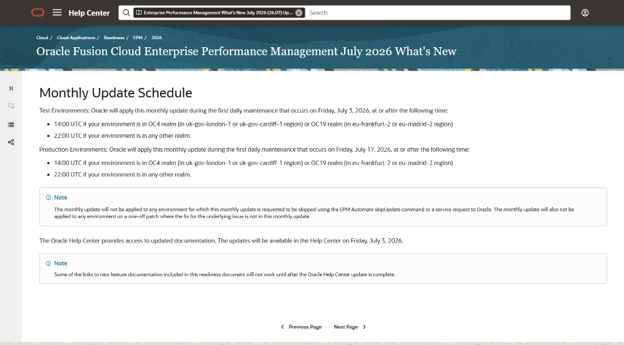

Hard to believe, but 2026 is already half over. And with the passing of another month comes the July 2026 Oracle EPM updates. There are no Planning updates this month, but here are some others that I find interesting. Updates will go to test environments July 3rd and prod environments July 17th.
Simulate Concurrent Usage EPM Automate Command and REST API Enhanced to Process Multi-Value Runtime Parameters
simulateConcurrentUsage continues to be enhanced, which is a good thing. The command will now support multi-value RTP parameters for Run Business Rules, Run Business Rulesets, Save Forms, and Execute Reports. This will provide more realistic usage testing.
New Video: Overview of New Regression Algorithms in Advanced Predictions
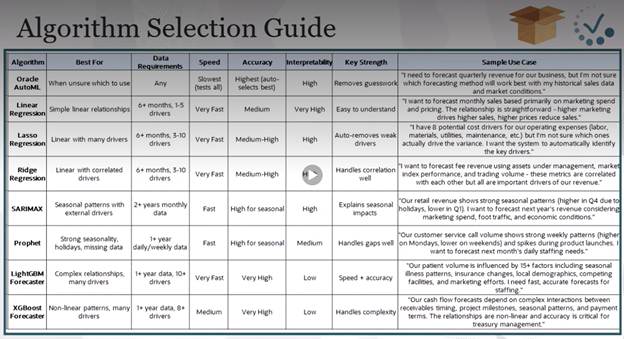
I normally don’t highlight new video releases, but this is a good one. It provides a nice overview of the new algorithms, and a comparison table of all the algorithms.
IPM Insights: New Period Movement Variance Insight Type Available
This new insight type will detect variances between the current period and a benchmark period. Several benchmarks can be used: year-on-year, period-on-period for the previous period, period-on-period for a custom period, and historical average. The threshold for the variance is defined by the administrator. Looks like I need to do some testing!
IPM Insights: Ability to View Insights from Forms and Dashboards
Woohoo! Insights can now be viewed from within forms and dashboards. The Insight is based on the POV of the current data view, which eliminates the need to navigate to the Insights list. Of course, the Insight will have to have been previously run so it is available to view from the form/dashboard.
Reporting Agent
This is an interesting feature. Using natural language questions, users can get answers about the data in Reports. Ask about things like trends, rankings, and comparisons.
@Mention Support within Review Comments and Doclet Notes
Seems like we should have had this a while ago, but better late than never. @mentions can be used in review comments and doclet notes to notify specific users about questions or feedback. This will help with collaboration on Packages.
IMPORTANT Actions and Considerations
Unicode Whitespace in Member and Alias Names
Previously, users could inadvertently include invisible Unicode whitespace characters, such as non-breaking spaces, at the end of member or alias names. While the service allowed these names, Essbase did not support or store them, resulting in silent failures during cube refresh operations. This often led to inconsistency between EPM Cloud and Essbase, potential duplicate errors, and customer support escalations.
The system now automatically trims any trailing Unicode whitespace from member and alias names during metadata validation and integration processes. This brings EPM Cloud and Essbase into strict alignment and eliminates instances where data is not written or members are out of sync due to invisible control characters. If the uniqueness of member or alias names among siblings is violated after trimming, users now receive a clear error message. If you previously relied on trailing spaces (including invisible Unicode spaces) for uniqueness, review your member and alias names to ensure they remain unique after trimming. Most customers are not expected to be impacted, but if you encounter an issue, create a Service Request for assistance.
July had a small number of updates, there are others that could be of interest to you, so you should read the full Oracle document.
As always, happy EPM’ng!

