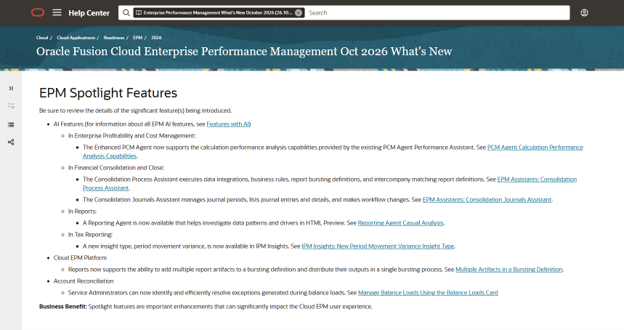

Could someone explain to me how it’s already time for the October 2026 Oracle EPM updates? I don’t think I fell asleep for a full month, but wow, time has really gone by fast. I am trying something different for this month’s update summary. I have been using the same format for a while and after seeing all the different ways others are sharing their information, it seems like time for a change. Please let me know in the comments if you like the new layout or not. Updates will go to test environments October 2nd and prod environments October 16th.
Configure EPM Cloud to Access Oracle Fusion Applications REST APIs with OAuth 2.0
- What’s New: EPM Cloud access to Oracle Fusion Applications REST APIs can now be configured to use OAuth 2.0.
- What It Means: A secure server-to-server integration between EPM Cloud and Oracle Fusion Applications.
- My Take: This is a necessary improvement to more securely configure access between EPM and Fusion. We have had several clients lately looking for OAuth 2.0 configurations like this.
Enhanced Home Page and Global Header Experience
- What’s New: Enhancements to the EPM home page grouping Announcements within an expandable drawer. Additionally, the home page adapts smoothly to different screen sizes, resolutions, and browser zoom levels.
- What It Means: A smoother home page experience. Announcements will be easier to navigate, and the clusters and cards will resize appropriately when screen size and resolution changes.
- My Take: A nice improvement the web experience. I particularly like the resizing of clusters and cards when the screen size or resolution is modified. This should make using the interface while traveling with just my laptop a better experience since it’s a much smaller screen than when I am docked to my desk monitor.
Support for Uploaded Private Key in copyToSFTP and copyFromSFTP Commands Invoked From Groovy Scripts
- What’s New: The EPM Automate commands copyToSFTP and copyFromSFTP will now support uploaded private key file when called from Groovy scripts.
- What It Means: You can pass the privateKey optional parameter of these EPM Automate commands from Groovy scripts, thus providing a more secure option to authenticate a user.
- My Take: Another improvement to enhance security, which is always a good thing.
Change Sign Support for Quick Mode Data Load
- What’s New: Change sign mappings are now supported in Quick Mode Data Load.
- What It Means: Greater flexibility when loading data with varying sign conventions.
- My Take: To be honest, I hadn’t realized Quick Mode was lacking in this functionality. It’s a good improvement.
Strengthened EPM Agent Credential Protection
- What’s New: The EPM Agent is being updated to use AES-GCM to protect newly created direct credentials. This includes cloud passwords, database credentials, and OAuth 2.0 tokens. This new format will help detect altered or corrupted credential data. Existing credentials remain readable for six months allowing time for administrators to change over.
- What It Means: This improves protection for sensitive credentials thereby reducing the risk of unauthorized access. The deployment of this new functionality while keeping existing configurations working gives administrators time to move to the better security without immediate impact.
- My Take: Clearly Oracle is taking security seriously for EPM. We are getting enhancements around security pretty much every month. If you are using EPM Agent, be sure to start your migration to this improved process sooner rather than later.
Enhanced Jobs Scheduler
- What’s New: An updated interface with tabs to organize job types. Also, the ability to enter a range of dates for the start date and end date.
- What It Means: The Jobs Scheduler will be easier to navigate.
- My Take: I am excited to see this improved Jobs Scheduler, especially the ability to enter a range of dates. That was something that frustrated me with creating schedules, it was too rigid.
Reporting Agent Causal Analysis
- What’s New: The Reporting Agent can run the causality analysis and provide top or bottom contributors.
- What It Means: Causality analysis has been available for a while, but now it can be run by the Reporting Agent making it easier for users to get the analysis.
- My Take: Guess I need to update my Narrative Reporting presentation. This is a great enhancement to the Reporting Agent. Until now, if you asked the Agent for top contributors in a report that had the causality analysis on it, the Agent could not return that information. Now it appears we don’t have to create a report with causality analysis at all to get the information, the Agent will do it.
Multiple Artifacts in a Bursting Definition
- What’s New: Multiple report artifacts can be added to a bursting definition. Up to ten artifacts can be added to the definition.
- What It Means: Previously, a bursting definition could have only one artifact (a report or a book). Now we can add multiple artifacts making it easier to distribute reports together in one distribution.
- My Take: Great improvement making bursting even more powerful. This will be fun to test, and it means I have to make more updates to my Narrative Reporting presentation. At this rate I may need to recreate the whole thing. 😊
Line Breaks in Generative AI Narrative Summaries
- What’s New: Criteria Definition can be configured to add line breaks between member level results in the GenAI narratives.
- What It Means: This improves the readability of the GenAI narratives. Previously, the results were in one big paragraph.
- My Take: Yep, looks like the whole presentation will need to rebuilt. Another great improvement to reports. Reading the GenAI narratives was painful, one big paragraph with no breaks. Now we can get manageable paragraphs based on the members we define in Criteria Definition.
IMPORTANT Actions and Considerations
Generative AI Features Require Cloud EPM 26.08 or Later by the End of January 2027
Generative AI functionality will require the August (26.08) or later update of Cloud EPM by the end of January 2027. Any environment that is not upgraded to 26.08 or late update by the end of January 2027 will no longer have access to Generative AI features.
Applies to: Account Reconciliation, Enterprise Data Management, Enterprise Profitability and Cost Management, Financial Consolidation and Close, FreeForm, Narrative Reporting, Planning, Profitability and Cost Management, Tax Reporting
EPM Automate Clients Earlier Than 26.09 Will Not Work with 26.12 and Later EPM Cloud Environments
Starting with the December (26.12) update, Cloud EPM environments will no longer support EPM Automate clients bundled with the 26.08 update or earlier.
Beginning with the 26.09 update, EPM Automate will change the format of the encrypted password (.epw) file to enhance its security. Cloud EPM environments on 26.09, 26.10, and 26.11 updates will be able to read the legacy .epw file format and the new file format created by EPM Automate that will be bundled with the 26.09 update.
Starting with the 26.12 update, Cloud EPM environments will accept only the new .epw file format generated by EPM Automate 26.09 or later.
To avoid authentication failures, Oracle recommends that you complete these steps after your environment is updated to 26.09. You must complete these steps before you can use EPM Automate to access 26.12 Cloud EPM environments:
- Upgrade EPM Automate to version 26.09 or later.
- Run the EPM Automate encrypt command to generate a new .epw file in the updated format.
The new .epw file will work with all Cloud EPM environments on update 26.09 or later.
Applies to: Account Reconciliation, Enterprise Data Management, Enterprise Profitability and Cost Management, Financial Consolidation and Close, FreeForm, Narrative Reporting, Planning, Profitability and Cost Management, Tax Reporting
This update has some nice things in it, I’m most excited about the improvements to reports. Be sure to read the full Oracle document for all the details on what I covered as well as items I did not mention.
As always, happy EPM’ng!


Really like the new layout—very clear, well-structured, and easy to understand at a glance.
It makes the key information much easier to follow.
Please keep the same onwards.Thanks for sharing .
Regards
Anwar
LikeLike