
June 2026 Oracle EPM updates are here. There are a few interesting ones, read on for what I found noteworthy, including a big change to data integration. Updates will go to test environments June 5th and prod environments June 19th.
EPM Automate and REST APIs
Several new EPM Automate commands and associated REST APIs are being release, and updates to some others.
- Get and Set Allowlist of Email Domains to Send Emails – These commands will allow emails to be sent from Cloud EPM only to allowable email domains. This enhances security by restricting email destinations from EPM.
- Updates to the cloneEnvironment and restoreEnvironment – The userAndPreDefinedRoles parameter has been renamed to usersAndApplicationRoles. The usersAndPreDefinedRoles parameter has been renamed to usersAndApplicationRoles. The purpose of the renames is to bring parity to how roles are referenced across EPM.
- New Reporting Option in the simulateConcurrentUsage – The optional parameter reportFile has been added to simulateConcurrentUsage command. This provides a way to access and download simulation results other than with email.
- Enhanced List Users REST API to Retrieve Direct and Indirect User Associations – The REST API List Users has been updated to return IDCS groups, application roles, EPM groups, and the granular roles associated with users. This provides better user access information in a single REST API call.
- New REST APIs to Import and Repeat Export Snapshot Artifacts – These APIs enable selective imports and repeat exports. This provides flexible snapshot artifact management for migration and reuse.
Manage Application Roles Tab Label Renamed to Manage Granular Roles
In Access Control, the tab Manage Application Roles has been renamed to Manage Granular Roles. Not a huge change but should help better align terminology across EPM.
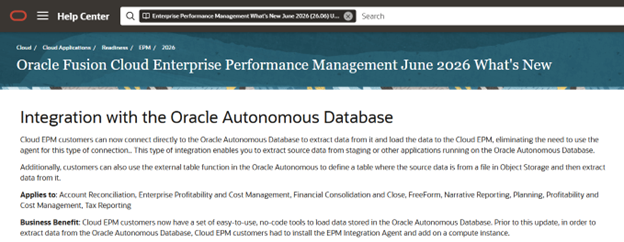
Integration with the Oracle Autonomous Database
This is the big one for the month. Cloud EPM can connect directly to Oracle Autonomous Database! Previously, the Integration Agent would have been needed for this process, now it is a direct connection to the database to extract data. This will provide much easier integration to the source data. Drill through is also supported but not write back.
Scheduling Cross-Application Data Maps from Job Scheduler
This is definitely one of my favorites this month. Data maps have been available for cross-application usage for a while, but they could not be managed in Job Scheduler until now. Previously, either manual runs or the use of Groovy rules was needed. This will improve automation scheduling.
Support for Generative AI Narrative Summaries
This one surprises me. The Gen AI features Describe Exception, Comparative Analysis, and Causality are now available in EPM Reports. Previously, this capability was only available in Narrative Reporting. These are the functions in AutoTextSummary used in Conditional Text. It is important to point out that Notes Summarization is not supported in EPM Reports, which remains exclusive to Narrative Reporting. Also, in Narrative Reporting new sample reports are available for each of these Gen AI features.
Support for Translating Gen AI Responses Using Machine Learning Template Files
The Gen AI textual responses (see above item about narrative summaries) can now be translated into different languages. The Machine Learning template files can be updated to do the translation.
Gen AI Formula Segment Support for Causality Analysis
Another interesting enhancement here. Causality Analysis can now be done on grid formulas to identify contributing analytic dimension members. This was previously only supported on non-formula cells. Looks like I need to update my Ascend and Kscope presentation slides about this update to Causality Analysis, or at least mention it.
Gen AI Enhanced Column and Dimension-Based Support for the Compare Use Case
Well, here’s another update I need to make for my presentations. Comparative Analysis will now allow you to compare columns regardless of the type of column. This means you can do the compare on data vs data, data vs formula, or formula vs formula. Analysis is getting better for sure.
Task Manager AI Assistants
If you are a Fusion customer along with your EPM subscription, you have access to Task Manager AI Assistants. This provides an integration with Fusion AI Studio enabling a chat-based experience for viewing task summaries, managing comments, deploying templates, and generating reports.
Support for User and Substitution Variables in Dashboards 2.0
The Apply Context option in Master Detail dashboards now supports context sensitive User and Substitution Variables. I need to test this out, I am not sure what this is providing, I need to see it.
Advanced Predictions: Support for Regression Algorithms
While this complicates what I planned on presenting at upcoming conferences, it is a good enhancement. Advanced Predictions will now support regression algorithms. Selections include Linear Regression, Lasso Regression, and Ridge Regression. These algorithms can be useful in situations where time series forecasting is not applicable.
Advanced Predictions: Ability to Select Multiple Target Accounts or Members for Output to Predict
I really like this one. Previously, only a single member could be selected for Output to Predict, i.e. one expense account. Now multiple members can be selected, i.e. level 0 of operating expenses. This simplifies setup, you can use one configuration for the Advanced Predictions instead of having multiple models for the different accounts to predict.
Update Regarding Predictive Planning in Smart View
I almost missed this one. Predictive Planning in Smart View is being retired and will no longer be available for download.
IMPORTANT Actions and Considerations
EPM Automate to Require Java 17 or Newer
Starting with the August 2025 (25.08) update, EPM Automate installations are supported on Java 17 or later only.
Generative AI Features Require Cloud EPM 26.04 or Later
Beginning in July 2026, Oracle will provide Generative AI functionality only for environments running the April (26.04) or later update. Environments that are not upgraded to 26.04 or later update by the end of July 2026 will lose access to Generative AI features.
As always, there are other items in the update that I did not cover, so you should read the full Oracle document. This is especially true of updates to Advanced Predictions and IPM Insights, I only covered a couple of them.
As always, happy EPM’ng!

